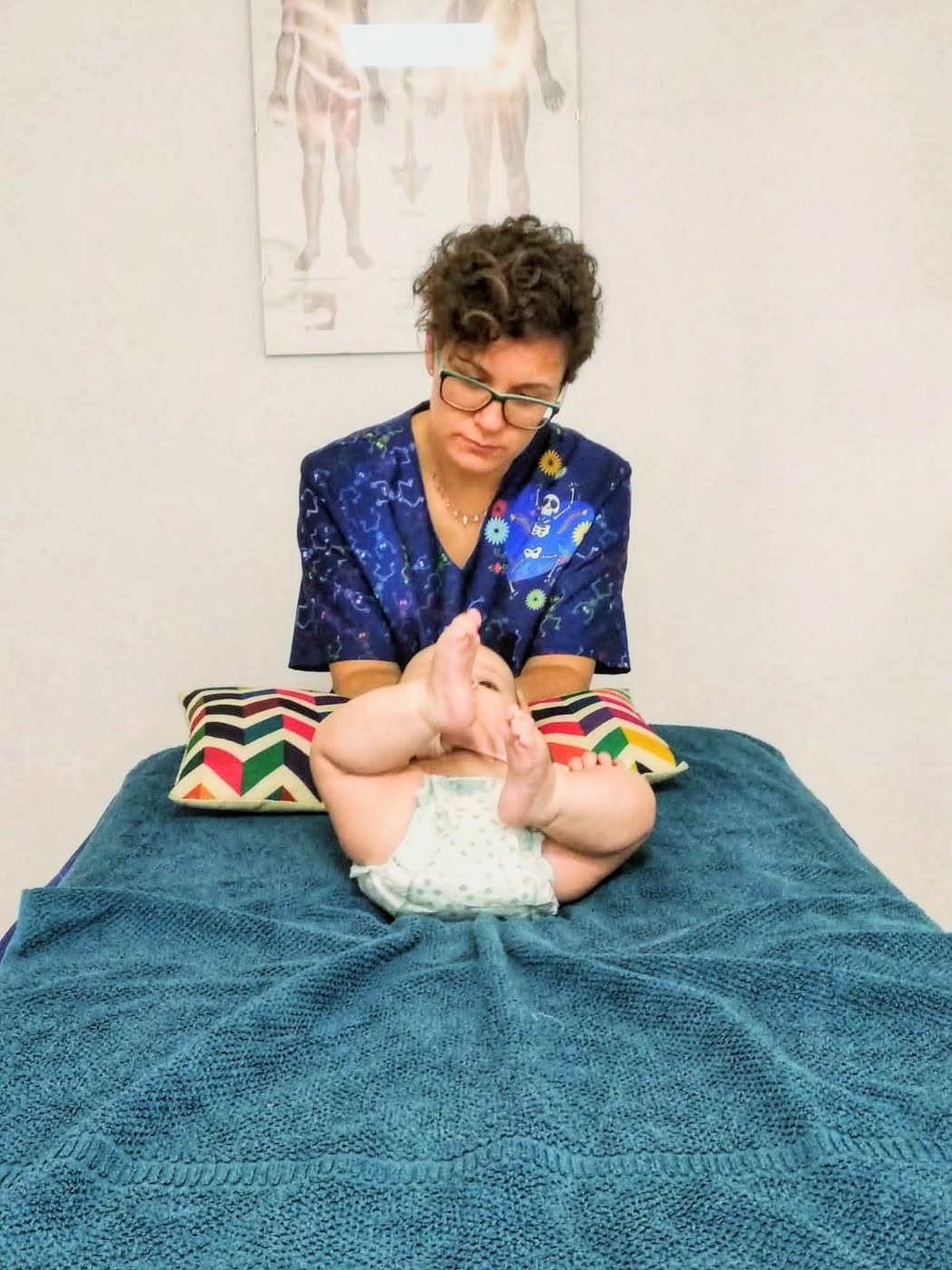
During pregnancy and birth, the baby’s skull is subjected to a series of pressures and changes so that it can pass through the birth canal during delivery.
Normally, over the first month of life those tensions dissipate and the bones that form the skull return to the optimal position, so that around the first year the baby’s skull consolidates and closes. On many occasions, however, if the birth did not unfold naturally, if it was prolonged or very fast, if the baby was very large in relation to the mother, if the mother’s pelvis was misaligned and so on, those tensions may not be able to dissipate on their own and need an osteopath’s help.
The cases we treat most often are:
- Cranial deformity (plagiocephaly), usually caused by the use of forceps or ventouse during delivery.
- Congenital torticollis.
- Infant colic (wind, constipation and so on).
- Gastro-oesophageal reflux.
- Respiratory problems (bronchiolitis and so on).
- Blocked tear duct.
- Acute otitis media in infants.
- Strabismus (squint).
- Curvature of the spine (scoliosis).
PAEDIATRIC PHYSIOTHERAPY
At Clínica Mà i Cos we accompany the youngest patients throughout their growth, with postural and developmental checks to anticipate deformities arising from growth or from poor psycho-neuro-motor development.
One of the main developmental conditions on the way to adulthood is scoliosis. Particular attention has to be paid to the growth spurt, which is around the ages of 10 to 12 in girls and 12 to 14 in boys.
Scoliosis is a deformity of the spine that begins as a sideways deviation in the anteroposterior plane and, in the most serious cases, can end as a three-dimensional deviation, since the spine rotates on itself.
Early detection is essential in order to try to slow the progression of the deformity and, with it, the problems that follow from it: respiratory and digestive problems, pain at an early age, degeneration of the musculoskeletal system and so on. It is essential to check the child’s posture from head to toe. A poor gait, a difference in leg length, poor dental occlusion or a vision problem can all lead to postural and structural problems in a child, scoliosis among them.
That is why at Clínica Mà i Cos we work with a wide network of professionals, so we can refer to whichever specialist is needed and take a genuinely multidisciplinary approach to prevention in children.
— Shortening of the muscle chains, above all the posterior chain.
— Growth-related pain.
— Psychomotor problems arising from poor integration of the primitive reflexes.
— Attention deficit, restlessness, anxiety and so on.
— Headaches and migraine.
— Dizziness.